
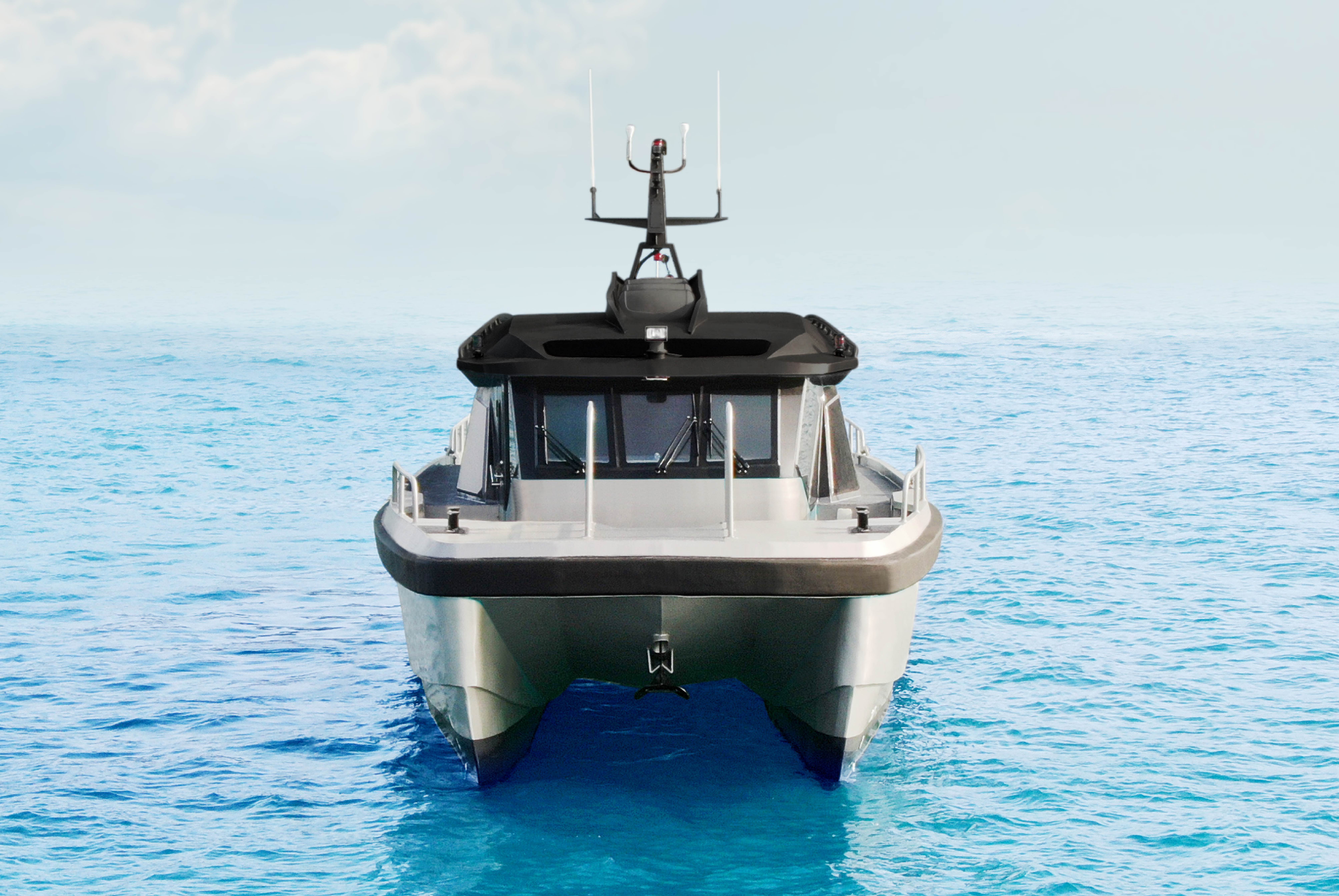
At Pyxis, we build electric catamarans because the twin-hull design is uniquely suited to the questions maritime operators are asking right now: How do we move more passengers, more safely, at lower cost, with zero emissions? The catamaran's geometry answers each of these questions with the same elegant logic. It is not a compromise between competing priorities. It is a design where every advantage reinforces the next.
Here is what that looks like in practice.
A catamaran earns its stability through beam — the wide separation between two hulls creates an inherently level platform that works with the sea rather than against it. The result is a vessel that sits steady in choppy harbour waters, holds its composure when passengers shift their weight, and returns to equilibrium without drama.
In commercial operations, this kind of stability pays dividends at every turn. Passengers board and disembark more quickly on a level deck. Crew fatigue is lower on longer shift patterns. Turnaround times tighten. For a passenger ferry operating in Singapore's busy anchorage — with its constant vessel traffic, wake and variable wind — a stable platform is both a safety standard and a genuine throughput advantage. The catamaran earns its keep in every cycle.
A catamaran's twin hulls are narrow by design. Each one cuts through the water cleanly, with a fraction of the wetted surface area of a broader, deeper hull — and wetted surface area is the primary driver of frictional resistance at the speeds relevant to harbour and coastal operations. The physics are straightforward: less resistance means less energy required to move the same payload at the same speed.
For electric vessels, this efficiency is not merely an operational benefit — it is what makes electrification commercially viable. Battery energy density remains the binding constraint on electric maritime range and payload. Every gain in hydrodynamic efficiency translates directly into extended range, greater passenger capacity, or reduced battery weight. The catamaran's slender hulls are, in this sense, one of the most important enabling technologies in the maritime energy transition.
The shift to electric propulsion is well underway in harbour craft, where voyage distances are predictable, charging infrastructure is practical to deploy, and the cost argument for electricity is already compelling. The catamaran is the hull form best positioned to make the most of this transition.
Its efficient hydrodynamics mean that a given battery capacity goes further. Its wide, stable platform offers generous space for battery packs, power management systems, and the cooling infrastructure that high-cycle commercial operations require. And its structural geometry — two hulls joined by a rigid crossbeam — lends itself naturally to distributed drivetrains, with independent motors on each hull delivering a level of redundancy that strengthens the operational and regulatory case for passenger service.
That redundancy matters in practice. An electric catamaran with independent drive systems on each hull can return to port safely with one system offline — a resilience that operators and certification bodies alike take seriously when approving vessels for commercial passenger work.
An electric catamaran is quiet. Without combustion engines, noise and vibration are reduced to the near-silent hum of electric motors and the gentle interaction of slender hulls with the water. On a stable platform, even wave-induced motion is softened. The cumulative effect is a crossing that feels calm, dignified, and unhurried — for crew and passengers alike.
This is not an incidental quality. Noise and vibration exposure is a genuine occupational health consideration for maritime crew working long shift patterns. A quieter vessel is a healthier working environment, and regulators and responsible operators are paying increasing attention to this. The passenger experience benefit is equally real: a crossing that arrives feeling restorative rather than wearing is one that people remember positively and choose again.
Monohulls have served the maritime industry for generations and will continue to have their place. But when the goal is clean, quiet, efficient and passenger-friendly harbour operations, the catamaran is uniquely aligned with what electric vessels need to deliver.
For Pyxis, the catamaran is not just a vessel shape. It is part of the operating system for maritime electrification. Because the future of harbour craft will not be defined by batteries alone. It will be defined by how intelligently every part of the vessel works together — from the hull, to the powertrain, to the software, to the charging ecosystem that supports it.
Two hulls. More possibilities.
That is why we build the way we do.
